OB Wheel Calculator: The 2026 Guide to Accurate Due Dates and Pregnancy Weeks
OB Wheel Calculator
Calculate an estimated due date from your last menstrual period and understand how gestational age, cycle length, ultrasound dating, and pregnancy milestones fit together.
OB Wheel Calculator
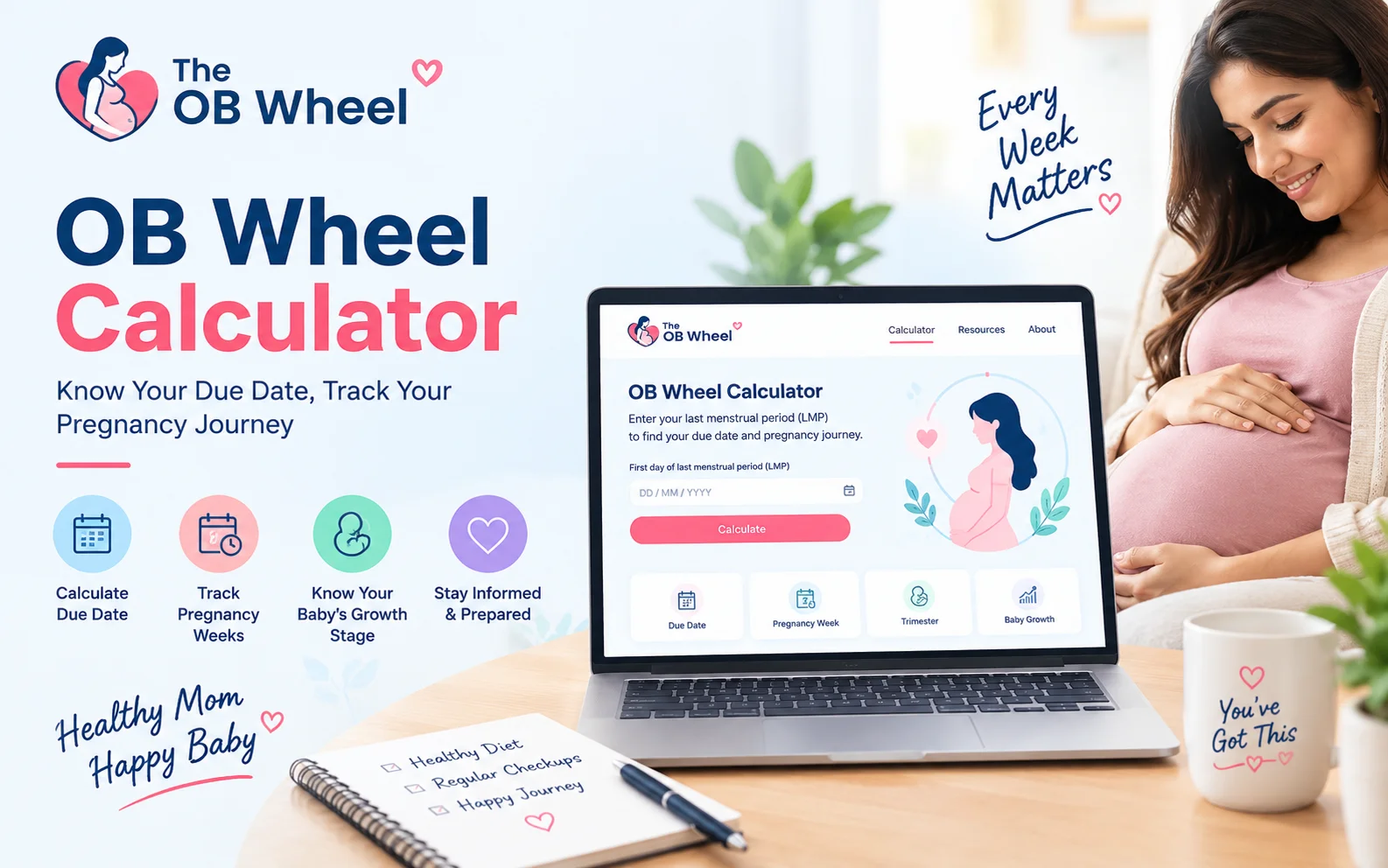
Calculate your estimated due date and pregnancy details.
Standard cycle length is 28 days.
12W 3D
First
31%
This calculator is for educational purposes only.
Your healthcare professional should confirm your official estimated due date.
That’s the whole trick. But the details around that trick decide whether your due date is a useful planning tool or a number that quietly steers you wrong for nine months.
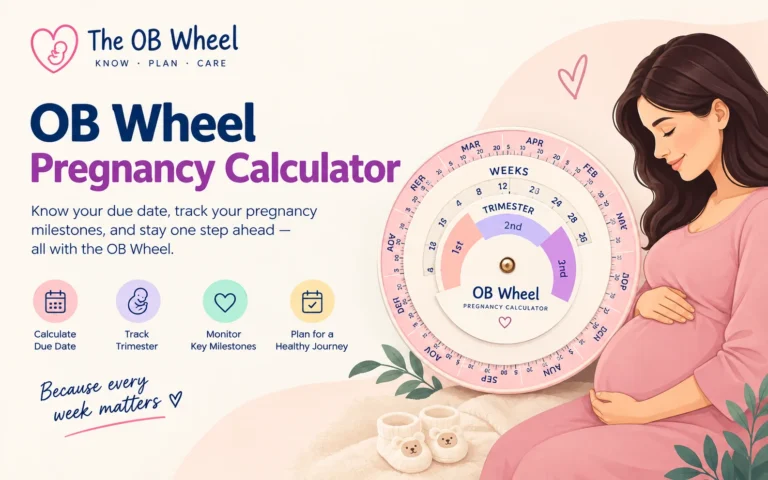
The old cardboard wheel sat on many obstetricians’ desks for decades. Today, the same basic math lives in an Ob Wheel Calculator online, in phone apps, and in search-engine calculators. This guide shows you how it works, why it sometimes disagrees with your ultrasound, and how to use it appropriately.
What Is an OB Wheel Calculator?
An OB Wheel Calculator is a digital version of the obstetric wheel, also called a gestational wheel or pregnancy wheel. It estimates:
- Estimated due date (EDD): the estimated date at which pregnancy reaches 40 weeks 0 days.
- Gestational age: how far along the pregnancy is, usually written as weeks + days, such as 12w3d.
- Trimester and milestone timing: approximate timing for common scans and pregnancy screening.
Key Terms, Defined Simply
| Term | Meaning |
|---|---|
| LMP | First day of your last menstrual period |
| EDD | Estimated due date |
| Gestational age | Pregnancy age measured from the LMP rather than conception |
| Naegele’s rule | A traditional LMP-based method corresponding approximately to 280 days |
| CRL | Crown-rump length, an ultrasound measurement used in early pregnancy dating |
Why it counts from LMP, not conception: ovulation often occurs around the middle of a menstrual cycle, but the exact day can vary and is not always known. Using the LMP provides a practical starting point for calculating gestational age. This is why someone can be described as approximately 4 weeks pregnant around the time a period is missed even though conception occurred later.
How the OB Wheel Calculator Works (The Math Behind It)
Naegele’s rule is the traditional basis of many LMP-based due-date calculations. It assumes a 28-day cycle with ovulation around day 14.
The formula:
Another traditional shortcut is to add 7 days to the LMP, subtract 3 months, and add 1 year.
Example: LMP = January 12, 2026 → +7 days = January 19 → −3 months = October 19 → EDD = October 19, 2026.
The traditional 280-day calculation combines approximately two weeks before ovulation with about 266 days from ovulation to delivery. It is a population-based estimate rather than a guarantee of when labor will occur.
Why it sometimes differs: menstrual cycles and ovulation timing vary. If a person’s cycle is consistently longer or shorter than 28 days, a simple 28-day assumption may not reflect their individual ovulation timing.
OB Wheel Calculator Pregnancy: A Copy-Paste Cycle-Length Adjustment
Some calculators include a cycle-length field because cycle length can affect an LMP-based estimate.
The adjustment formula:
| Your Cycle | Adjustment | LMP: Jan 12, 2026 Gives EDD |
|---|---|---|
| 24 days | −4 days | Oct 15, 2026 |
| 28 days | 0 days | Oct 19, 2026 |
| 32 days | +4 days | Oct 23, 2026 |
| 35 days | +7 days | Oct 26, 2026 |
The example shows why cycle length can matter when using an LMP-based calculation. Your healthcare professional may use additional information when establishing the pregnancy’s official estimated due date.
OB Wheel Calculator Week by Week: What to Expect and When
Here’s an OB Wheel Calculator week by week view using the example LMP of January 12, 2026 with a 28-day cycle. Swap in your own dates.
| Gestational Week | Date Example | Typical Milestone |
|---|---|---|
| Week 4 | Feb 2, 2026 | A missed period may occur and a home pregnancy test may become positive |
| Week 8 | Mar 2, 2026 | Early pregnancy assessment or dating ultrasound may occur when clinically indicated |
| Week 12 | Mar 30, 2026 | First-trimester screening may be performed during the appropriate window |
| Week 20 | May 25, 2026 | Common anatomy ultrasound window |
| Week 24 | Jun 22, 2026 | Gestational diabetes screening is commonly performed during 24–28 weeks |
| Week 28 | Jul 20, 2026 | Third trimester begins under the commonly used clinical grouping |
| Week 37 | Sep 21, 2026 | Early-term period begins |
| Week 39 | Oct 5, 2026 | Full-term period begins |
| Week 40 | Oct 12, 2026 | 40w0d, the traditional estimated due date, occurs on Oct 19, 2026 |
Trimester ranges: first trimester through 13w6d, second trimester from 14w0d through 27w6d, and third trimester from 28w0d onward under this commonly used grouping.
OB Wheel Calculator Online vs App vs Download
You have several ways to calculate pregnancy dates. Each format can be useful in a different situation.
| Format | Useful For | Watch Out For |
|---|---|---|
| OB Wheel Calculator online | Quick checks without installing an app | Tools that ignore cycle length or provide unclear privacy information |
| Ob Wheel Calculator app | Daily tracking, reminders, and week-by-week information | Data privacy and subscription features |
| Ob Wheel Calculator download | Offline use, printing, clinics, or personal records | Outdated versions and hard-coded dates |
OB Wheel Calculator Google Search
Searching for an OB Wheel Calculator on Google may surface a calculator or other quick-answer tool. These can be useful for a basic LMP-to-EDD conversion, but the underlying assumptions matter.
Before relying on any calculator, check whether it:
- Accepts cycle length.
- Shows gestational age in weeks and days.
- Supports ultrasound-based dating or IVF dating when relevant.
- Clearly explains how the calculation is performed.
- Provides understandable information about health-data privacy.
The D.A.T.E. Framework: A Workflow You Can Copy
Here’s a simple four-step framework for using an OB Wheel Calculator as a starting point rather than treating the first number you see as the final answer.
D — Document your LMP.
Record the first day of your last menstrual period as accurately as possible.
A — Adjust for cycle length.
If your cycles are consistently shorter or longer than 28 days, consider the cycle-length adjustment used by the calculator.
T — Test with ultrasound.
When appropriate, ultrasound measurements can provide important information for establishing gestational age.
E — Establish one official EDD.
Let your clinician determine the estimated due date used for your pregnancy care and use that date consistently.
The wheel provides a fast estimate, while clinical dating may incorporate ultrasound and other information. Having one established EDD also helps avoid confusion when different apps or calculators display different dates.
Case Study: Priya’s Two Due Dates
Priya had an LMP of January 12, 2026, but her cycles typically lasted about 35 days.
Default 28-day calculation: October 19, 2026
Cycle-adjusted calculation: October 26, 2026
Illustrative ultrasound-based date: October 25, 2026
A difference between an LMP-based estimate and an ultrasound-based estimate does not automatically mean that one date is wrong. Clinical redating depends on gestational age, the ultrasound measurement, the size of the discrepancy, and the circumstances of the pregnancy.
In practice, your clinician determines whether the pregnancy should be redated according to applicable clinical guidance rather than applying a single threshold to every pregnancy.
| Measure | Initial Estimate | After Clinical Assessment |
|---|---|---|
| EDD | Oct 19 / Oct 26 depending on method | Clinician-established date based on the available evidence |
| Dating basis | LMP and cycle assumption | Clinical assessment and, when appropriate, ultrasound |
A difference of several days can matter when pregnancy care is being scheduled around gestational-age thresholds, which is why the established EDD should come from your healthcare professional.
What the Data Says About Pregnancy Dating
Your estimated due date is a planning reference, not a guaranteed delivery date. Only a small percentage of babies are born on the exact estimated due date.
The commonly used clinical terminology divides term pregnancy into:
- Early term: 37w0d through 38w6d
- Full term: 39w0d through 40w6d
- Late term: 41w0d through 41w6d
- Postterm: 42w0d and beyond
First-trimester ultrasound using crown-rump length is generally the most accurate ultrasound-based method for establishing gestational age when the embryo or fetus can be appropriately measured. The criteria for changing an established EDD vary according to gestational age and the size of the discrepancy.
Preterm birth remains common worldwide. The CDC reports that roughly one in ten births in the United States occur before 37 completed weeks, while the WHO has estimated that millions of babies are born preterm globally each year.
These numbers matter because gestational age affects how clinicians interpret fetal growth, pregnancy milestones, and the care provided when a baby is born at different stages of pregnancy.
Common Mistakes When Using an OB Wheel Calculator
- Using the wrong LMP date. Spotting is not necessarily the same as the first day of a menstrual period.
- Ignoring cycle length. A consistently shorter or longer cycle can affect an LMP-based estimate.
- Trusting several apps at once. Different tools may use different assumptions.
- Counting from conception. Gestational age is conventionally counted from the LMP rather than the conception date.
- Treating the EDD as a deadline. An estimated due date is an estimate, not a guaranteed delivery date.
- Skipping the scan comparison. Your clinician may consider ultrasound dating when determining the official EDD.
- Using a stale printable. If you use an older calculator or wheel, verify the underlying formula and assumptions.
Your OB Wheel Calculator Checklist
☐ Note your LMP (first day of your menstrual period)
☐ Note your typical cycle length
☐ Run an OB Wheel Calculator and record the EDD and gestational age
☐ Discuss pregnancy dating and ultrasound timing with your clinician
☐ Compare LMP-based dating with ultrasound dating when appropriate
☐ Confirm the official EDD used for your pregnancy care
☐ Track pregnancy milestones according to your clinician’s recommendations
Conclusion: Use the OB Wheel Calculator as Your Starting Line
The OB Wheel Calculator is a quick way to estimate gestational age and an estimated due date from the LMP. Use the LMP carefully, consider cycle length, and discuss ultrasound dating with your healthcare professional when appropriate.
Whether you prefer an OB Wheel Calculator app, an online version, or a printable download, the goal is the same: have a clear pregnancy-dating reference that can be confirmed and used consistently throughout your care.
For more pregnancy-dating information, visit The OB Wheel
.
Key Takeaways
- An Ob Wheel Calculator commonly uses LMP + 280 days as its starting calculation.
- Cycle length can change an LMP-based estimated due date.
- First-trimester ultrasound is generally the most accurate ultrasound-based approach to establishing gestational age.
- The estimated due date is an estimate rather than a guaranteed delivery date.
- Use the EDD established by your healthcare professional for pregnancy care.
- Week-by-week milestones are easier to follow when they are tied to an established gestational age.
Short Summary
An Ob Wheel Calculator estimates a pregnancy due date using the first day of the last menstrual period and the traditional 280-day calculation. Cycle length can affect the estimate, while ultrasound dating may provide additional information about gestational age. Use the calculator as a starting point, understand its assumptions, and confirm the official estimated due date with your healthcare professional.
FAQs
1. What is an Ob Wheel Calculator and how accurate is it?
An Ob Wheel Calculator estimates gestational age and an estimated due date from the LMP using the traditional 280-day calculation. It provides a starting estimate; the accuracy of LMP-based dating depends partly on how accurately the LMP is known and on menstrual-cycle characteristics. Your clinician may use ultrasound and other information when establishing the official EDD.
2. Is an Ob Wheel Calculator online as reliable as the physical wheel?
If both use the same underlying 280-day calculation and assumptions, they can produce the same LMP-based estimate. Online calculators may offer additional inputs such as cycle length, but you should check what assumptions the specific calculator uses.
3. Can I use an Ob Wheel Calculator app for week-by-week tracking?
Yes. Pregnancy apps may display gestational age, trimester information, milestones, and reminders. For medical decisions, use the estimated due date established by your healthcare professional rather than relying solely on an app.
4. Why does my Ob Wheel Calculator due date differ from my ultrasound?
An LMP-based calculator uses assumptions about cycle length and ovulation timing. Those assumptions do not apply perfectly to every pregnancy. Ultrasound dating can therefore produce a different estimate. Whether the pregnancy should be redated depends on gestational age, the ultrasound measurement, the size of the difference, and clinical guidance.
5. Is there an Ob Wheel Calculator download I can use offline?
Printable wheels, PDFs, and spreadsheets can be used offline. If you use one, check that it is based on the appropriate calculation and has not been superseded by newer clinical guidance.
Looking for More Pregnancy Dating Information?
Explore more pregnancy-dating information and resources from The OB Wheel.
This article and calculator are provided for educational and informational purposes only. They are not a substitute for professional medical advice, diagnosis, or treatment. Pregnancy dating should be confirmed by your qualified healthcare professional, particularly when the LMP is uncertain or ultrasound dating differs from the LMP-based estimate. Do not use this information to make medical decisions without consulting your doctor or midwife.