OB Wheel Pregnancy Calculator: The Complete 2026 Guide to Dating Pregnancy Like a Pro
Direct Answer: An OB Wheel Pregnancy Calculator is a rotating disc or digital tool that converts a patient’s last menstrual period into an estimated due date, gestational age, trimester milestones, and key screening windows using the familiar 280-day pregnancy calculation.
I’ve watched brand-new nursing students spin a cardboard OB wheel for the first time and get that little “oh, that’s all it is?” moment. That reaction is the whole story of this tool. It looks like a magic decoder ring. It’s actually just arithmetic wearing a costume.
This guide breaks down exactly how the OB Wheel Pregnancy Calculator works, where it gets things wrong, and how to use it — or its app equivalent — the way a clinician actually would.
What Is an OB Wheel Pregnancy Calculator, Really?
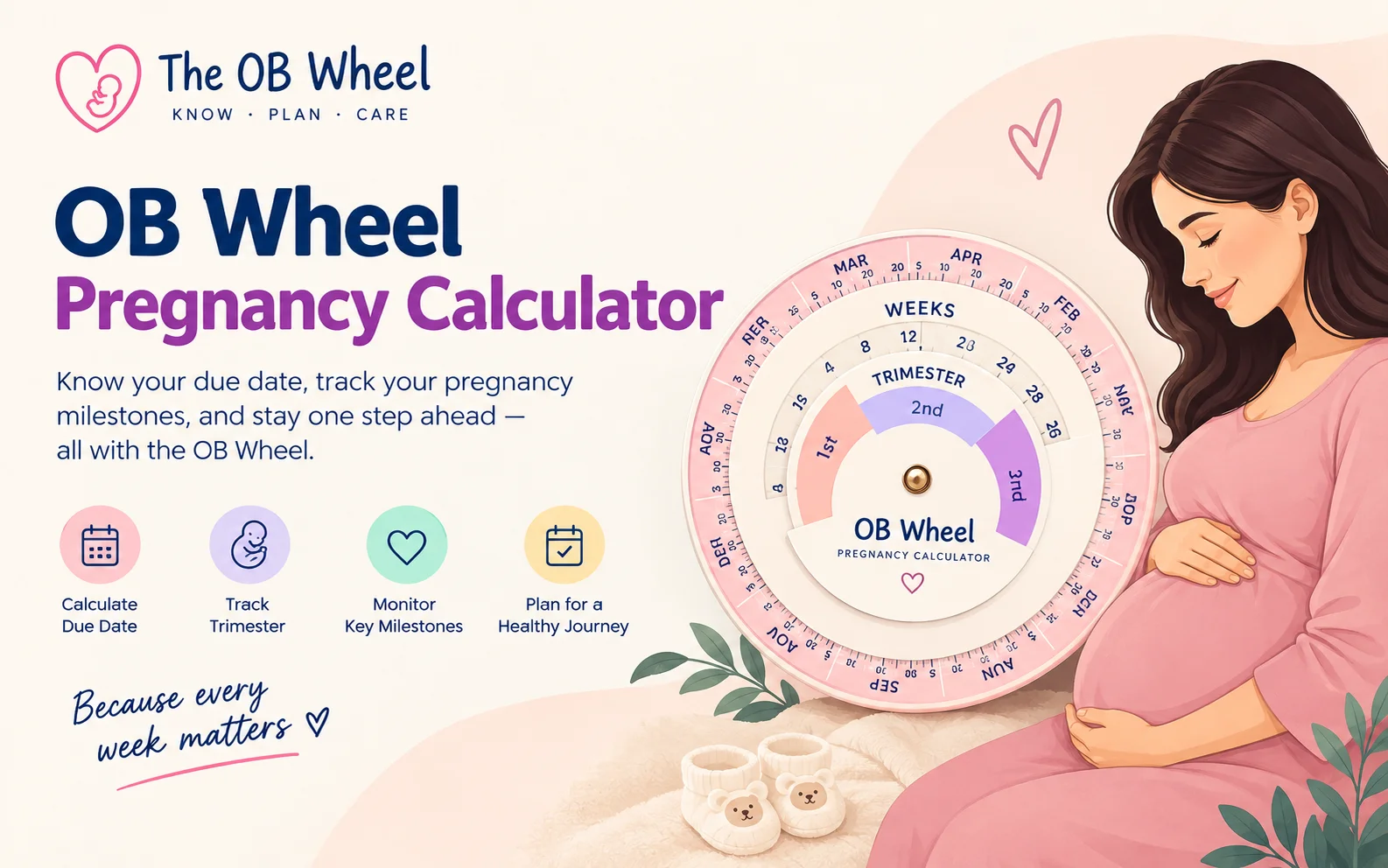
An OB wheel, also called a pregnancy wheel, gestational wheel, or EDD calculator, is a dating tool built on Naegele’s Rule: take the first day of the last menstrual period (LMP), add one year, subtract three months, and add seven days.
That’s the entire engine. Everything else — fetal size charts, trimester bands, screening markers, and other information displayed on a digital pregnancy wheel — is built around that basic calculation.
OB Wheel Pregnancy Calculator
Estimate your due date, gestational age, trimester and pregnancy milestones.
Calculate by Last Menstrual Period
Enter the first day of your last menstrual period and your average cycle length.
Pregnancy Progress
32.5%
Mid-pregnancy
Due Date
Pregnancy Milestones
First Trimester
Second Trimester
Third Trimester
Pregnancy dating should be confirmed with a qualified healthcare professional.
This demo does not replace medical advice, diagnosis, or professional care.
Definition Check
Gestational Age vs. Fetal Age:
A pregnancy “dated” at 6 weeks by LMP is usually only about 4 weeks post-conception. Gestational age and fetal or conceptional age are therefore not the same number.
Why the Wheel Still Beats Guessing (Even in 2026)
The OB Wheel Pregnancy Calculator has been around for generations because it solves a very specific prOBlem simply: estimating pregnancy dates from an LMP.
- It needs only one input a patient can usually recall — the LMP.
- It requires no imaging equipment.
- It gives an instantly reproducible calculation.
- It provides a practical starting point for pregnancy dating.
That simplicity is why OB wheels remain familiar in nursing education, prenatal care workflows, and pregnancy calculator applications.
The Formula Behind the Wheel (With a Worked Example)
Or, the way the physical wheel encodes it: add 1 year, subtract 3 months, add 7 days.
LMP = March 1
March 1 → add 1 year → March 1, next year → subtract 3 months → December 1 → add 7 days = December 8
Why 280 days specifically? Human pregnancy averages 40 weeks measured from the LMP. Because ovulation typically happens around day 14 of a 28-day cycle, the actual embryonic age at birth is closer to 266 days. The additional roughly two weeks are included because the LMP is generally easier to identify than the exact conception date.
Mini Case Study: The 35-Day Cycle PrOBlem
A patient I’ll call Priya — a composite example, not a real patient record — has a 35-day cycle instead of the standard 28. Her ovulation may occur around cycle day 21 rather than day 14.
Running her LMP through a standard 28-day OB wheel can produce an EDD that is roughly a week earlier than an estimate based on her longer cycle. That difference can matter when interpreting gestational age and pregnancy milestones.
The Correction:
Cycle-length adjustment methods, including formulas such as Parikh’s formula, can account for cycles that differ from 28 days. Ultrasound dating may also provide an independent assessment when appropriate.
This is an important limitation of a basic physical wheel. A digital OB Wheel Pregnancy Calculator App can provide more flexibility by allowing the user to enter a cycle length rather than automatically assuming 28 days.
OB Wheel vs. Ultrasound Dating: The Real Comparison
The clinical approach to pregnancy dating is layered. LMP information, cycle history, examination findings, assisted-reproduction dates when applicable, and ultrasound findings can all contribute to establishing the estimated due date.
Practically, the wheel is a fast first estimate while ultrasound can provide an important confirmation or correction mechanism when the clinical circumstances call for it.
The Data NOBody Puts in the Infographic
- Naegele’s Rule provides an estimate rather than a guarantee of the actual delivery date.
- Only a small percentage of babies are born on their exact estimated due date.
- Full-term is clinically defined as 39 weeks 0 days through 40 weeks 6 days.
- Early term is 37 weeks 0 days through 38 weeks 6 days.
- Birth before 37 weeks is classified as preterm, while birth at or after 42 weeks is post-term.
- Twin pregnancies are generally delivered earlier than singleton pregnancies and are monitored using different clinical expectations.
These distinctions are why clinicians generally treat an EDD as an estimate and use the broader clinical picture when making pregnancy-management decisions.
A Simple Framework: The 3-Layer Dating Check
Here’s a practical mental model for checking a pregnancy date, whether you’re a student, doula, educator, or building an app.
Run the standard OB wheel calculation. This provides the provisional EDD.
Ask whether the cycle is actually 28 days. If not, account for the cycle length or flag the discrepancy for clinical review.
Cross-check against relevant clinical information, particularly first-trimester ultrasound when appropriate.
Skipping the correction steps can mean relying too heavily on an assumption about menstrual-cycle timing that may not fit the individual pregnancy.
Common Mistakes People Make With the OB Wheel Pregnancy Calculator
Assuming every cycle is 28 days.
The standard wheel uses a 28-day cycle assumption, but individual cycles can vary.
Confusing gestational age with fetal age.
A pregnancy dated at 10 weeks by LMP is generally around 8 weeks from conception.
Treating the EDD as a guarantee.
An estimated due date is an estimate, not a promise of the exact delivery day.
Ignoring irregular cycles.
Irregular cycles can make the LMP less reliable as a dating reference.
Not checking appropriate ultrasound dating.
Early-pregnancy ultrasound can be particularly useful when LMP information is uncertain or inconsistent with other findings.
Before / After: Why the Correction Step Matters
Before: Wheel Only
LMP-based EDD calculated with a flat 28-day assumption can make the pregnancy appear further along when the patient’s cycle is substantially longer.
After: 3-Layer Framework
Cycle length is considered and appropriate clinical information, including ultrasound when indicated, is used to establish a more informed gestational-age estimate.
The Key Point:
The same LMP can produce a different clinical picture when cycle length and independent dating information are properly considered.
FAQs About OB Wheel Pregnancy Calculator
1. What is an OB Wheel Pregnancy Calculator used for?
It’s used to estimate a due date and current gestational age from the first day of a patient’s last menstrual period using the traditional 280-day pregnancy calculation.
2. How accurate is an OB Wheel Pregnancy Calculator?
Its accuracy depends heavily on how reliable the LMP is and whether the patient’s cycle is close to the standard 28-day assumption. Accuracy can be reduced when cycles are irregular or the LMP is uncertain.
3. Can an OB Wheel Pregnancy Calculator App replace ultrasound dating?
No. A good calculator provides a fast initial estimate, while ultrasound can provide clinical dating information when the LMP is uncertain or when there is a meaningful discrepancy.
4. Does the OB Wheel Pregnancy Calculator work for irregular cycles?
Not reliably on its own. The standard calculation assumes a 28-day cycle, so irregular or substantially longer or shorter cycles may require cycle-length adjustment or clinical confirmation.
5. Why do due dates from an OB Wheel Pregnancy Calculator rarely match the actual birth date?
Because the EDD is an estimate of the expected timing of delivery rather than a guarantee of the exact day a baby will be born.
Key Takeaways On OB Wheel Pregnancy Calculator
- The OB Wheel Pregnancy Calculator uses the traditional LMP + 280-day calculation.
- The standard calculation assumes a 28-day cycle with ovulation around day 14.
- Cycle length and LMP reliability can affect the usefulness of the basic calculation.
- Ultrasound can provide an important independent assessment of gestational age when clinically appropriate.
- A practical dating approach considers the LMP baseline, cycle characteristics, and clinical confirmation rather than relying on the wheel in isolation.
Summary Of OB Wheel Pregnancy Calculator
The OB Wheel Pregnancy Calculator is a simple, two-century-old dating concept that remains useful because it is fast, straightforward, and requires only a date.
But speed isn’t the same as precision. Whether you’re using a physical wheel or an OB Wheel Pregnancy Calculator App, the result is best understood as a starting estimate that can be refined when cycle length, ultrasound findings, or other clinical information indicate that additional dating assessment is appropriate.
This content is for educational purposes and is not a substitute for individualized medical advice, diagnosis, or prenatal care. Pregnancy dating should be confirmed by a qualified healthcare professional when menstrual dates are uncertain, cycles are irregular, or clinical findings do not match the LMP-based estimate.
Want to learn more?
Check out The OB Wheel for more information, pregnancy dating tools, and helpful resources.